PFAS Distribution in Lower Casco & Merrymeeting Bay Watersheds
Chris Aeppli, PhD, Environmental Chemist & Senior Research Scientist,
Bigelow Ocean Lab for Ocean Sciences
Wednesday, January 14, 2026 at 7:00 pm
Register for Zoom Presentation
Christoph Aeppli
Christoph Aeppli is an environmental chemist and senior research scientist at Bigelow Laboratory for Ocean Sciences in East Boothbay, Maine. He leads a research program in marine pollution and a testing center for “forever chemicals” (PFAS). Chris studies the fate of organic chemicals in aquatic environments, with a focus on PFAS and oil residues from marine oil spills. His current work includes tracing the sources and pathways of PFAS in coastal waters such as Casco Bay. Aeppli’s research investigates the physical and chemical processes that control how these contaminants move, change, and affect marine life.
This project collected and shared data about the distribution, levels, and source contributions of PFAS in Casco Bay and its watershed including the Kennebec and Androscoggin River and Merrymeeting Bay. It includes bay-wide sampling, comprehensive PFAS analysis, assessment of source contributions (from facility effluent, stormwater, leachate from biosolid and firefighting foam impacted sites), and engagement with stakeholders and decision makers.
PFAS are a large group of emerging contaminants that are of national concern for ecosystem and human health. PFAS have multiple sources and primarily travel via groundwater and surface water, and, therefore, reach coastal ecosystems. The large number of PFAS compounds in the environment as well as the lack of detailed PFAS data in estuaries represents a major uncertainty about the scale and sources of the coastal PFAS problem. For Casco Bay, the sparse available data from water, sediment, and biota show that PFAS are present at highly variable concentrations, with several potential sources.
This project’s comprehensive sampling and PFAS analysis of 40 compounds provide high-quality baseline data. Statistical analysis of PFAS data will delineate the importance of various sources of PFAS into the lower watershed and in particular look at effects of the BNAS PFAS spill. This project aims to provide guidance to decision makers for appropriate source control measures and regulations to ensure the long-term health of Casco Bay.
Category: Advocacy
-
PFAS Distribution in Lower Casco & Merrymeeting Bay Watersheds
-
Coalition Calls for End to Endangered Species Loophole
[vc_row][vc_column][vc_column_text css=””]Contact: Emily Bastian, National Vice-Chair, Native Fish Coalition: info@nativefishcoalition.org 207-965-5098 Ed Friedman, Chairman, Friends of Merrymeeting Bay: edfomb@comcast.net 207-666-3372
A coalition of 19 organizations and 10 prominent scientists and conservationists, including many former state employees, are supporting a bill that would ensure protections for all federally-listed threatened and endangered species found in Maine. LD883: An Act to Protect Endangered Species Whose Life Cycles Include Maine Land or Waters would require the Commissioners of Inland Fisheries and Wildlife (IFW) and Marine Resources (DMR) to recommend state listing for all species of fish and wildlife listed as Threatened or Endangered pursuant to the U.S. Endangered Species Act of 1973, and which inhabit land or waters in this state for any part of their life cycles. The proposed legislation covers all federally listed terrestrial and marine animal species, including birds, mammals, reptiles, amphibians, fish, and invertebrates. The purpose of the U.S. Endangered Species Act (ESA) is to protect and recover imperiled native species and the ecosystems they depend on to prevent their extinction. Under the ESA, “Threatened” refers to species likely to become endangered within the foreseeable future, and “Endangered” means a species in danger of extinction throughout all or a significant portion of its range. “Wildlife extinctions world-wide are at an all-time high” said Senator David Miramant, sponsor of the bill. “We hope LD 883 will close some management loopholes in Maine and help bring a number of our species back from the brink,” he added. Maine is one of only ten states (and the only one in the northeast) that does not mandate or recommend state-level listing of federally-listed species. “From 1979 to 1996, Maine’s definition of “Endangered” under the Maine Endangered Species Act (MESA) included federally-listed species. In 1996, LD 164 took responsibility for listing away from scientists and gave it to the commissioners of IFW and DMR and the legislature. Twenty-five years later it’s time we gave it back,” said Ed Friedman, Friends of Merrymeeting Bay Chairman. There are currently 16 federally-listed Threatened and Endangered birds, mammals, reptiles, and fish found in Maine. Of those, only ten, or 60%, are listed at the state level. The six federally-listed species found in Maine that are not listed at the state level include the red knot, Canada lynx, blue whale, green turtle, Atlantic salmon, and Atlantic sturgeon. Dwayne Shaw, Executive Director of the Downeast Salmon Federation noted Atlantic salmon are one imperiled species falling through the cracks in management and recovery. “By most estimates, there are currently fewer than 100 returning adult Atlantic salmon actually born in the wild of wild parents. We are obligated to future generations to ensure this iconic fish survives,” Shaw said. “There is no biological reason for Maine not to list a species that U.S. Fish & Wildlife Service or National Marine Fisheries Service has listed as Threatened or Endangered,” said Emily Bastian, Vice Chair of Native Fish Coalition. “If they are threatened or endangered at the national level, they are by default threatened or endangered at the state level. Inclusion of all threatened or endangered species under either MESA or the Maine Marine Endangered Species Act of 2003 will help improve management and restoration efforts across state agencies.” This legislation is supported by the following organizations and individuals: Atlantic Salmon Federation – John Burrows, Executive Director US Programs: jburrows@asfmaine.org Center for Biological Diversity – Catherine Kilduff, Senior Attorney: CKilduff@biologicaldiversity.org Center for Cetacean Research and Conservation – Nan Hauser, President: info@whaleresearch.org Downeast Salmon Federation – Dwayne Shaw, Executive Director: swayne@mainesalmonrivers.org Elliotsville Foundation – Lucas St. Clair, President: lucas@elliotsvilleplantation.org Endangered Species Coalition – Tara Thorton, Deputy Director: tthornton@endangered.org Friends of Merrymeeting Bay – Ed Friedman, Chairman: edfomb@comcast.net Friends of Sebago Lake – Roger Wheeler, President: friendsofsebago@yahoo.com Forest Ecology Network – Jonathan Carter, Director: forestecologynetwork@gmail.com Grow L+A River Working Group — Peter Rubins, Chairman: prubins1@gmail.com Native Fish Coalition – National – Bob Mallard, Executive Director: info@nativefishcoalition.org Native Fish Coalition – Maine Chapter – Tom Johnson, Maine Chair: tjohnsonfly@yahoo.com Passamaquoddy Tribe at Sipayik – Chris Johnson, Fisheries Biologist Sipayik Env.Dept: cjohnson@wabanaki.com Patagonia – Dana Wilfahrt, Environmental Coordinator: Dana.Wilfahrt@patagonia.com RESTORE: The North Woods – Jym St. Pierre, Maine Director: jym@restore.org The Coyote Center — Geri Vistein, Founder: gvistein@gmail.com The Rewilding Institute – John Davis, Executive Director: john@rewilding.org Upstream Watch – Amy Grant, President: agrant7108@gmail.com Wildlands Network – Christine LaPorte, Eastern Program Director: christine@wildlandsnetwork.org Edward Baum, Fisheries Scientist, Retired Program Coordinator for Maine Atlantic Sea-Run Salmon Commission Topher Browne, Journalist and author of “Atlantic Salmon Magic” Mark Des Meules, Former Science & Stewardship Director for TNC VT, Former ED Land for Maine’s Future, Maine Atlantic Salmon Collaborative Joan Garner Trial, Ph.D., Retired MDIFW Fisheries Biologist, Atlantic Salmon Commission, DMR Bureau Sea Run Fisheries Albert M. Manville II, Ph.D., Retired Senior Wildlife Biologist USFWS, Certified Wildlife Biologist for The Wildlife Society Paul Nickerson, Retired USFWS and co-author of the federal rule listing Atlantic salmon in Maine Ray “Bucky” Owen, Ph.D., Former MDIFW Commissioner Catherine Schmitt, Journalist and author of “The President’s Salmon: Restoring the King of Fish and its Home Waters” Matthew Scott, Emeritus, AFS, AIFRB; Retired Chief Biologist Maine DEP and former Deputy Commissioner MDIFW Mark Whiting, Ph.D., Retired DEP Biologist for DEP Salmon Rivers Program[/vc_column_text][/vc_column][/vc_row]
-
Brunswick Androscoggin Dam Killing Fish
[vc_row][vc_column][vc_column_text css=””]Download the PDF
Summary:
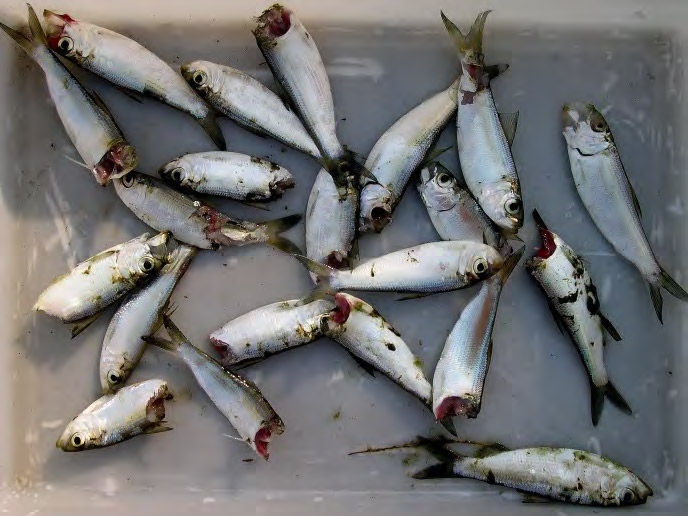
On October 15–16, 2016, Friends of Merrymeeting Bay (FOMB) discovered a massive fish kill at the Brunswick/Topsham Dam on the Androscoggin River, operated by Brookfield Energy. Observers found hundreds of thousands of young-of-the-year alewives and other fish dead near the dam’s outlet and Green Bridge. FOMB volunteers counted around 500–800 dead fish at the boat ramp alone.
FOMB reported the incident to Brookfield via its emergency line. When the site was revisited Tuesday, dam maintenance was underway—turbines were shut off and a diver was present, while Taintor gates were opened on the Topsham side to allow fish passage.
Under normal conditions, migratory fish must navigate through a narrow 18-inch pipe with a grated intake and a flow of just 40 cubic feet per second, adjacent to turbine intakes that deliver thousands of cfs—5,075 cfs for Unit 1, and 2,672 cfs through Units 2 and 3. Fish drawn toward these high-flow turbines often suffer fatal injuries due to decapitation, concussive forces, and pressure-related damage such as ruptured swim bladders, all of which were observed in this event.
FOMB emphasized that similar mortality events occurred at Brookfield’s Union River dam in Ellsworth. Despite years of legal action under the Endangered Species Act and Clean Water Act to improve fish passage, interim species protection plans implemented during litigation proved inadequate. FOMB criticized these plans and stated Brookfield and involved agencies must be held accountable.[/vc_column_text][/vc_column][/vc_row][vc_row][vc_column][dt_gallery_masonry bwb_columns=”desktop:3|h_tablet:3|v_tablet:3|phone:2″ image_border_radius=”0px” project_icon_border_width=”0px” include=”353,354,351,352,349,350,347,348,346,345″][/vc_column][/vc_row]
